
FAQ
1. How to upgrade the K1 firmware?
Please ensure the device battery level is above 70%. This upgrade process applies to all K1 firmware versions. Older firmware versions (below 1.2.3) require multiple sequential upgrades: below 1.2.4→1.2.4→2.4.1→3.0.2→3.1.1→3.2.1...... Direct version skipping is not supported.
- Download the K1 firmware file from the official website on your computer. Do not extract the firmware file after downloading.
- Turn on the device and ensure it is connected to your phone (Lixel GO). Enable "USB Mode" in settings.
- Connect the device to your computer using a USB cable. Locate the USB drive root directory in your file manager and drag the firmware file (keep it as a compressed package) directly to the root directory.
- Safely eject the USB device from your computer, or disable "USB Mode" in Lixel GO settings.
- Turn off the device and restart it. The device will enter firmware upgrade mode, indicated by alternating red and green flashing lights.
- Wait patiently for the upgrade to complete. Once successful, the indicator light will change to a steady green. Do not power off the device or remove the battery during the upgrade process.
- Connect the device using the app to confirm the firmware version.
2. The K1 did not enter the alternating red-green flashing state after restart, or the firmware version did not change after the update?
Possible causes:
- Verify the pre-upgrade version number and device SN. Ensure no skip-level upgrade is performed. K1 versions below 1.2.4 must first be updated to 1.2.4, then 1.2.4→2.4.1→3.0.2→3.1.1→3.2.1...... Direct version skipping is not supported.
- The firmware package was extracted, renamed, or the system automatically appended characters like "(1)" to the filename. Do not make any modifications after downloading from the official website.
- USB Mode must be enabled (use the app, or press the power button once to get white light, then press again). The firmware must be placed at the same level as the model folder, outside the folder rather than inside it.
- Battery must be above 70%. The battery button indicator should show at least 4 green bars.
- If the USB-TypeC cable is damaged, the copied firmware package may be smaller in size. Try a different cable.
If the issue persists, please contact official technical support.
3. How to perform a proper scan with the K1?
Please refer to the "Capture Guidelines" document for the corresponding product on the official website download page. Key points are as follows:
Initialization phase:
- Avoid shaking the device. Place it on a flat surface and let it start while stationary. Wait at least 10 seconds after the point cloud appears on the phone screen before picking up the device.
- During initialization, the operator should avoid blocking the LiDAR. The device LiDAR should face an area with abundant features.
Scanning process:
- Walk at a normal pace and avoid making large, fast turns or sudden stops.
- Tilt the device slightly forward by approximately 15 degrees for a more complete field of view. Generally, do not tilt beyond 20 degrees.
- Maintain a distance of at least 0.5 meters from the scan target.
- When scanning outdoors with heavy pedestrian or vehicle traffic, avoid pointing the LiDAR at dynamic objects for extended periods.
- When scanning multiple rooms or floors indoors, open all doors in advance. Pass through doorways slowly and pause briefly at the doorway.
4. Does the K1 support resuming a scan from a breakpoint?
No, it does not.
5. Can the reflective target paper used for LixelStudio accuracy verification be replaced with a different shape or size?
No. You must use the circular reflective target paper provided in the device case (original size is 4 cm). Otherwise, the software accuracy verification function cannot perform automatic recognition.
6. How to clean dust from the K1 LiDAR?
Use the non-woven cloth provided in the device case, and gently wipe in one direction.
7. What are the storage precautions for the K1 handle battery?
- After daily use, charge the battery to full promptly.
- Batteries that are fully charged but unused for a long period must be recharged at least once every 3 months.
- Batteries with very low or completely depleted charge must be recharged within 3 days.
Battery damage caused by not following the above requirements cannot be repaired and is not covered under warranty.
8. What is the lifespan of the K1 handle battery?
After 300-500 charge-discharge cycles, the battery capacity will decrease to 70%-80% of its initial value, at which point the battery is considered to have reached the end of its lifespan. Please charge it fully after each use, store it in a cool and dry environment, and recharge it periodically if not used for extended periods.
9. What does the K1 IP54 protection rating mean?
IP54 indicates the device enclosure protection against solid objects and water:
- The first digit 5: Provides protection against harmful dust accumulation, but cannot completely prevent dust entry. Dust may enter but will not affect normal device operation.
- The second digit 4: Provides protection against water splashes from any direction.
Therefore, the K1 is suitable for various indoor environments and some outdoor environments where these conditions may be encountered.
10. Does XGRIDS RTK support 1+1 mode?
No, it does not.
11. Does the K1 require enabling RTK advanced settings?
The K1 does not require any changes to RTK advanced settings. Keep the default disabled state.
12. How to troubleshoot abnormal RTK indicator lights on the app?
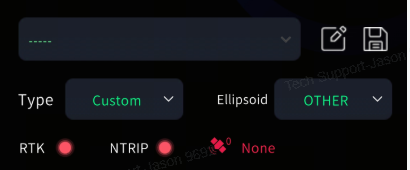
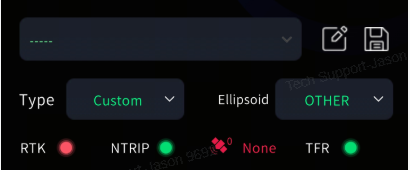
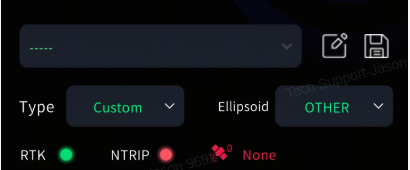
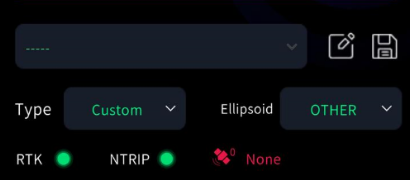
Troubleshoot based on the RTK and NTRIP indicator light status in the app:
Both RTK and NTRIP show red: The RTK module is not properly connected to the device. It is recommended to power off, remove and reconnect the RTK module, then restart the device.
RTK red, NTRIP green: The device is in quick-connect mode and the RTK module is not properly connected. Follow the same steps as above.
RTK green, NTRIP red: The NTRIP network is not connected. Check whether the phone has internet access, or try switching to a different CORS account.
Both RTK and NTRIP are green, but satellite count is 0: RTK hardware failure. It is recommended to power off and ensure the RTK module is securely installed, then retry. If another RTK module is available, cross-test to determine whether a factory repair is needed.
13. How to use the K1 tilted RTK bracket?
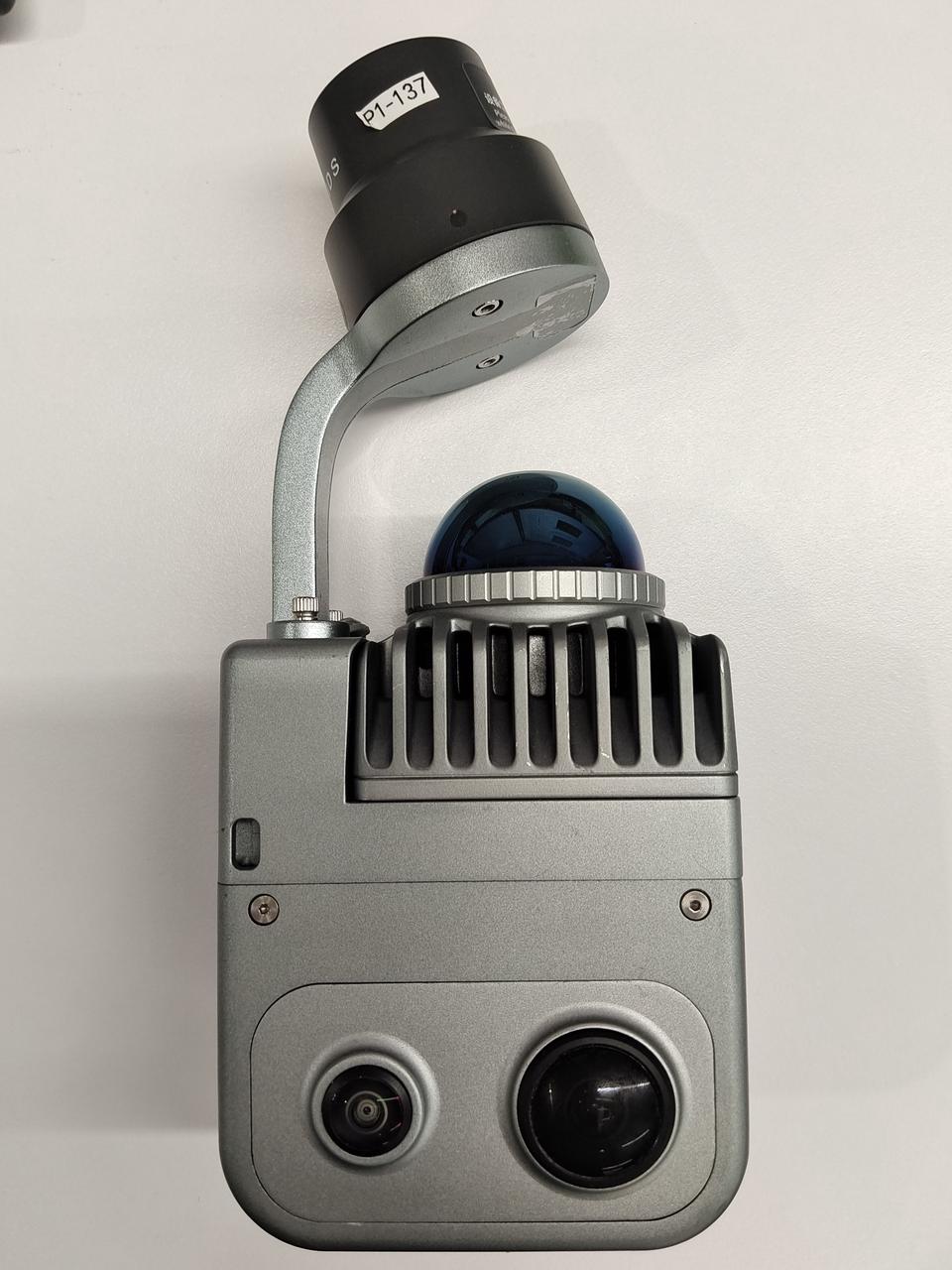
The K1 tilted RTK bracket supports firmware version 1.2.3 and later. If you have not received the latest bracket, please contact your regional sales representative for an update.
14. How does the K1 output panoramic photos for Coloring and Mesh?
When performing Project Processing in LixelStudio, check the "Output Panoramic Photos" option. After processing is complete, the photos will be saved in the output directory. Both Coloring and Mesh features require this option to be enabled.
15. How long should K1 data collection last to ensure good Coloring results?
The scanning session must last at least 2 minutes, and you must keep moving during collection. Do not keep the scanner stationary in one position. Pay attention to how you hold the device and avoid blocking the panoramic camera or having objects on one or both sides of the camera for extended periods.
16. Can the K1 memory card be replaced with a different one?
No, it cannot be replaced.
17. What is the K1 data transfer speed?
The maximum transfer speed is 75MB/s.
18. What does the K1 scanning distance "0.1m to 40m@10%, 70m@80%" mean?
This indicates the effective ranging distance of the K1 under different reflectivity conditions:
- 0.1m to 40m@10%: When the target object reflectivity is 10%, the effective scanning distance is 0.1 to 40 meters.
- 70m@80%: When the target object reflectivity is 80%, the effective scanning distance is 70 meters.
19. Can the K1 export video from its built-in cameras?
No, video export is not supported. You need to use LixelStudio for Project Processing and check the "Output Panoramic Photos" option.
20. What is the K1 operating temperature range?
The operating temperature range is -20 to 50 degrees Celsius. Exceeding this range may affect normal device operation. When the ambient temperature exceeds 50 degrees Celsius, device performance and reliability may be affected, and it could potentially cause device malfunctions.
21. What happens when the K1 battery is critically low?
A pop-up warning will appear when the remaining battery level reaches 10%. At this point, you should save your data and stop scanning to prevent the device from shutting down automatically before data is properly saved. Ignoring the warning and continuing to scan is considered improper operation, and there is no guarantee that data will be fully saved or processed correctly afterward.
22. What to do if the K1 project folder date does not match the actual scan time?
- Provide the device SN number to technical support to check whether the device has a rechargeable RTC version.
- If it is a rechargeable version, connect the handle battery to charge the RTC battery. It requires continuous standby or at least a cumulative 10 hours of use to fully charge. Once the RTC is fully charged, it can maintain standby for approximately 100 days. If the device is not used for a long time, it is recommended to power it on regularly every two weeks for at least one and a half hours.
- Upgrade the firmware to the latest version on the official website. Use app version 1.1.1 or above and reconnect the device to the phone to automatically sync the time.
23. What do the differential status values in the K1 GNSS file mean?
- 0: Invalid positioning (indicator light red).
- 1: Single point solution (indicator light blue).
- 4: Fixed solution (indicator light green).
- 5: Float solution (indicator light blue).
24. Does the K1 support explosion-proof operation?
The device does not currently support explosion-proof operation.