XGRIDSDocs
  • 简体中文
  • English
  • 繁體中文
  • 日本語
  • Deutsch
  • Español
  • Italiano
  • Français
  • Русский
  • 简体中文
  • English
  • 繁體中文
  • 日本語
  • Deutsch
  • Español
  • Italiano
  • Français
  • Русский
  • PortalCam

    • Product Overview
    • Basic Operation
    • Using the LCC Scan App
    • Maintenance and Care
    • FAQ
  • Lixel K Series

    • Lixel K1

      • Product Overview
      • Basic Operation
      • Device Activation and Connection
      • Scanning Workflow
      • Acquire Point Cloud Data with Absolute Coordinate
      • Map Fusion
      • Route Planning Suggestions for Typical Scenes
      • Precautions
      • FAQ
    • Lixel K2

      • Product Overview
      • Basic Operation
      • Device Activation and Connection
      • Scanning Workflow
      • Acquire Point Cloud Data with Absolute Coordinate
      • Map Fusion
      • Route Planning Suggestions for Typical Scenes
      • Precautions
      • FAQ
  • Lixel L Series

    • Lixel L2 Pro

      • Product Overview
      • Basic Operation
      • Device Activation and Connection
      • Scanning Workflow
      • Acquire Point Cloud Data with Absolute Coordinate
      • Measure Point
      • Appendix
      • FAQ
  • Lixel Studio

    • Version and Copyright
    • Installation and Activation
    • Software Interface
    • File Operations
    • Project Processing
    • Tools
    • 2D Drawing
    • Applications
    • Settings
    • Device Connection
  • Lixel CyberColor

    • LCC Studio

      • Getting Started
      • Version and Updates
      • Download and Installation
      • Interface Overview and Navigation
      • Before Reconstruction
      • Model Reconstruction
      • Single Model Reconstruction
      • Map Fusion
      • Aerial-Ground Fusion
      • Aerial Reconstruction
      • My Models
      • Other Features
      • Settings and Account
      • Converter
      • Video Reconstruction
      • FAQ
    • LCC Scene Editor

      • Version & Updates
      • Account & Login
      • Product Overview & Home
      • Editor Interface
      • Scene Navigation Modes
      • File
      • Settings
      • Edit Operations
      • Window
      • Global Toolbar
      • Assets & Properties
      • Left Toolbar
      • Viewpoints
      • Portal
      • Skybox
      • Annotations
      • Measurement
      • Flythrough
      • Scene Report
      • 3D Layout
      • Mini-Map
      • Preview Mode (Viewer)
      • Help
      • FAQ
      • Spawn Point
    • LCC Model Editor

      • Version and Updates
      • User Guide
      • Overview and Interface
      • File Operations
      • Selectors
      • Editing Models
      • Measurement
      • Color Grading
      • Asset Management
      • Settings and Help
      • FAQ
    • Capture Guide

      • Overview
      • Capture Devices Overview
      • General Capture Principles
      • Indoor Scene Capture
      • Outdoor Scene Capture
      • Large-Scale Capture (Map Fusion)
      • Aerial-Ground Map Fusion Capture
      • Object Capture
      • People Capture
      • Video Reconstruction Capture
      • HD Enhancement
      • Control Points (Lixel P1)
      • FAQ and Troubleshooting
    • Version History
  • Plugin & SDK

    • Unreal

      • Introduction
      • Quick Start - Windows
      • Quick Start - Linux
      • Quick Start - Quest3
      • Editions and Licensing
      • Rendering
      • Visual Settings
      • Normals and Lighting
      • Scene Editing
      • Performance Parameters
      • Performance Guide
      • Third-party and Engine Plugin Integration
      • Proxy Mesh
      • Loading Animation
      • Collision
      • Navigation System Support
      • Single Layer Water Support
      • Localization
      • FAQ
      • Troubleshooting
      • Logging and Diagnostics
      • Contact Us
      • API Reference

        • ALCCActorBase
        • ULCCComponentBase
        • ULCCComponent
        • ULCC2Component
        • SOG / SPZ / PLY Actors
        • ALCC2ProxyMesh
        • ALCCClippingVolume
        • ALCCSectionPlane
        • ULCCUtilLibrary
        • Enums
        • Structs
      • Changelog

        • v3.3.1
        • v3.0.0
        • v2.2.1
        • v1.0.0
        • v0.9.0
        • v0.8.0
        • v0.7.1
        • v0.6.1
        • v0.5.2
        • v0.4.1
        • v0.4.0
        • v0.3.0
        • v0.0.5
        • v0.0.4
        • v0.0.3
        • v0.0.2
        • v0.0.1

Letting 3DGS Take Part in Scene Lighting: Normal Generation Modes

Overview

3DGS produces no real geometric normals. When Lit mode is enabled, a normal must be generated for every pixel so the standard Unreal Engine lighting pipeline works.

LCC4Unreal offers 4 normal generation modes (LCC2 pipeline only), each making a different trade-off between visual stability, shading quality, and authoring cost.

Choosing a Mode

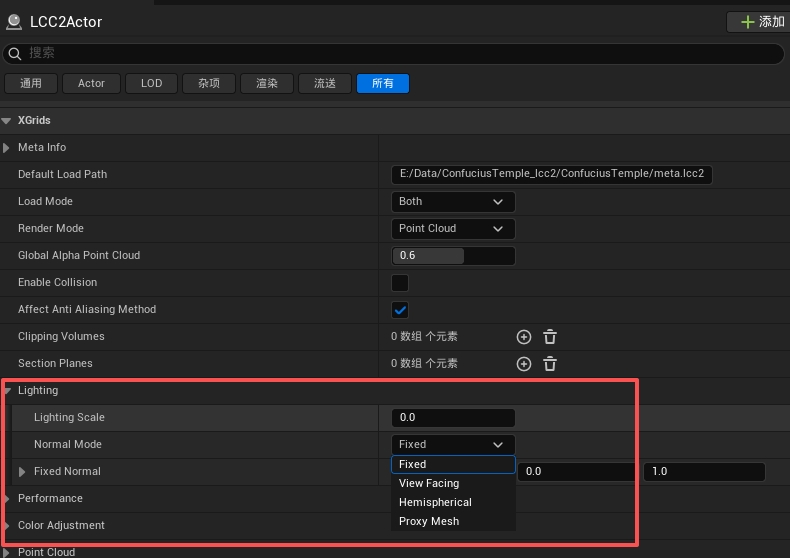
Set NormalMode on ULCC2Component:

ModeCamera-stableShape shadingSetup effortGPU cost
FixedYesNoneMinimalLowest
ViewFacingNoNoneMinimalLow
HemisphericalYesApproximateNeeds tuningLow
ProxyMeshYesRealNeeds modelingMedium
Normal Mode options for normal generation

Selecting the normal generation mode on the component

Fixed (default)

Uses a single world-space normal for the entire splat. All pixels share one brightness value.

  • Default direction: world up (0, 0, 1)
  • Change the direction through the FixedNormal property (no normalization required)
  • Fully stable, unaffected by camera movement
  • No shape shading

Use cases: architectural visualization, top-down daylight scenes.
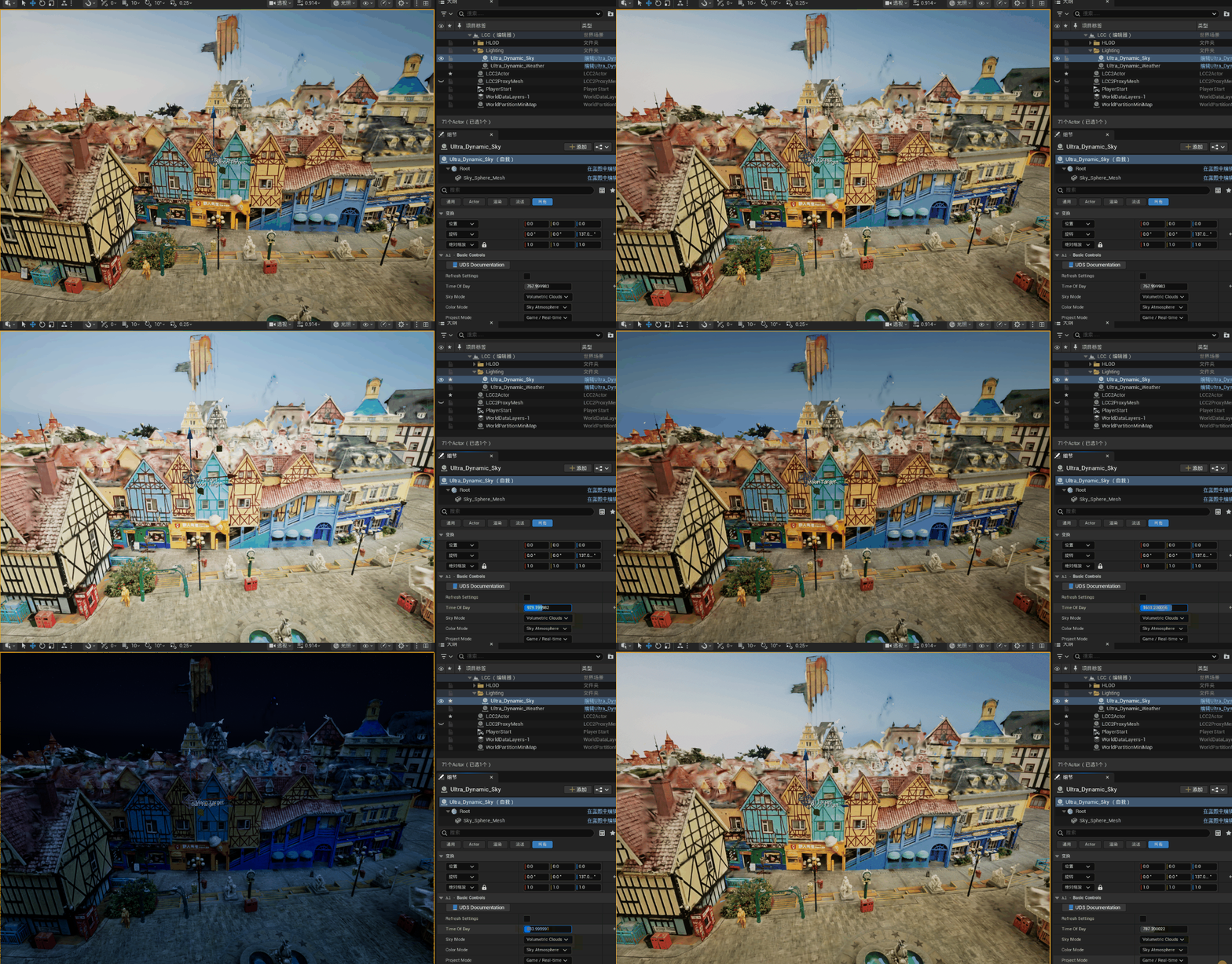
Lighting with the Fixed normal mode

Lighting with the Fixed normal mode

ViewFacing

Normals face the camera, producing even illumination.

  • Simple, works out of the box
  • Brightness changes as the camera rotates

Use cases: quick previews, interactive exploration.
Lighting with the ViewFacing normal mode

Lighting with the ViewFacing normal mode

Hemispherical

Maps screen position onto a fixed world-space hemisphere, producing a smooth curved distribution of normals.

Configurable parameters:

  • NormalPole: the surface facing direction, default (1, 0, 1)
  • NormalHemiSpread: the strength of the shading variation, range 0~4, default 0.5

Characteristics:

  • Stable lighting, unaffected by camera movement
  • Directional lights produce a natural arc-shaped light-to-dark transition
  • Still an approximation, not real shape shading

Use cases: large outdoor scenes, drone capture, high-quality shading without proxy geometry.
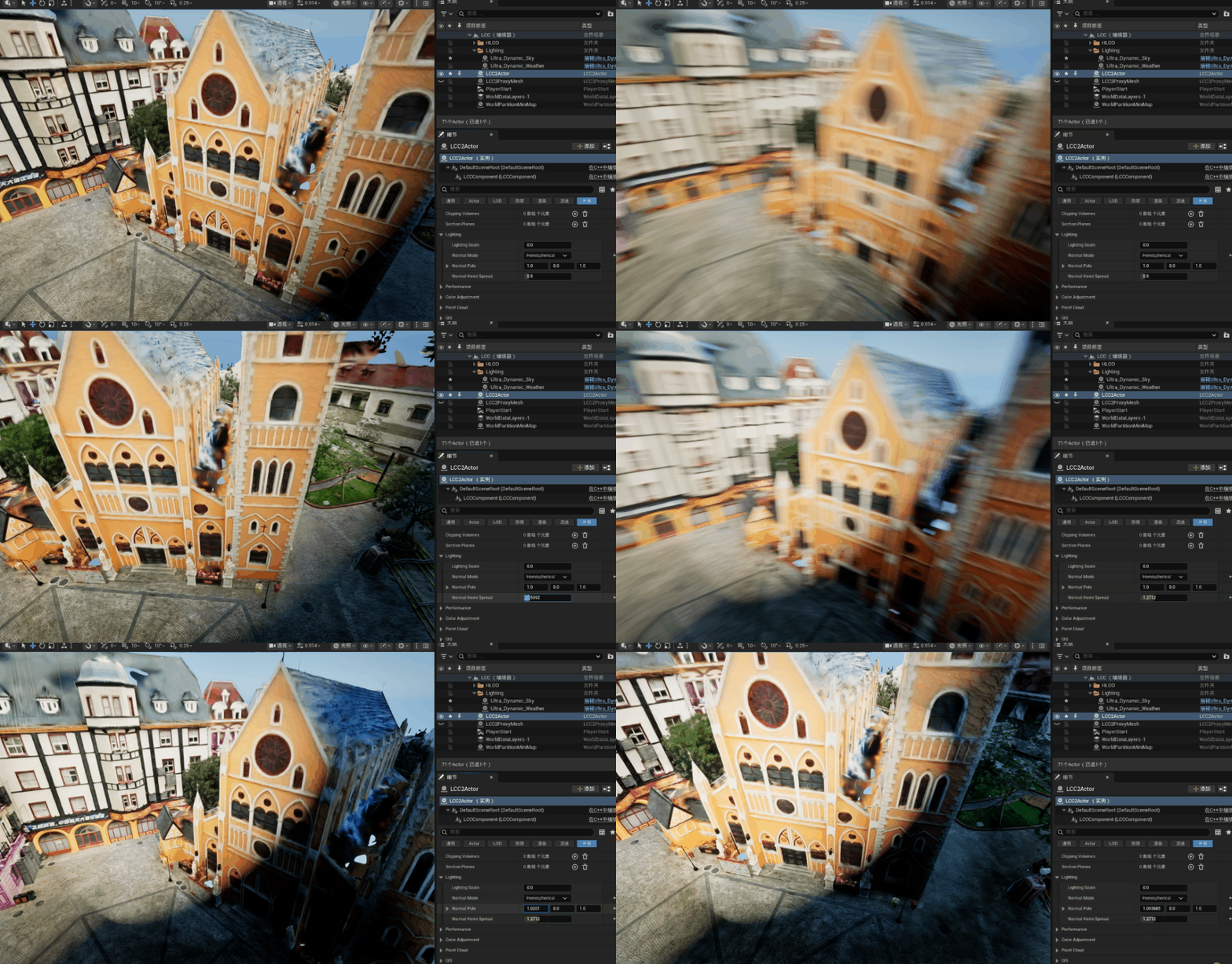
Lighting with the Hemispherical normal mode

Lighting with the Hemispherical normal mode

ProxyMesh (Pro edition feature)

The only mode with real shape shading. Uses proxy mesh Actors placed in the scene to provide real normals and depth.

  • Requires placing an ALCC2ProxyMesh Actor and assigning a StaticMesh
  • Pairing is purely spatial, with no manual association required
  • Falls back to Fixed automatically without a license; see Editions and Licensing
  • The stored property value is not modified

See ProxyMesh Guide for details.
Lighting with the ProxyMesh normal mode

Real shape lighting with the ProxyMesh normal mode

LCC2 Lighting Scale

The LightingScale property (0~1) controls the brightness of the original 3DGS colors before scene lighting:

  • 0 = fully driven by scene lighting
  • 1 = keeps the captured brightness intact

Because captured colors already contain baked lighting, a lower value reduces overexposure.

Prev
Visual Settings
Next
Scene Editing